Agentic AI in 2026: The Complete Guide to Autonomous Business Workflows

For three years, businesses experimented with AI chatbots, copilots, and assistants. The results were underwhelming. A 2025 MIT Media Lab study found that 95% of organizations saw no measurable returns from AI adoption. The problem was not the technology. The problem was the paradigm.
We were using AI to help humans work. In 2026, we are using AI to do the work.
This shift has a name: agentic AI. And it is the most significant change in business operations since the internet.
Gartner predicts that 40% of enterprise applications will embed AI agents by the end of 2026, up from less than 5% in 2025. Salesforce has already reduced its customer support headcount from 9,000 to 5,000 using agentic systems. Investors are calling 2026 "the year AI comes for labor."
This guide will show you exactly what agentic AI is, how it differs from the AI you have been using, where it creates value, and how to implement it before your competitors do.
What Is Agentic AI?
Agentic AI refers to artificial intelligence systems that can autonomously plan, execute, and adapt to achieve goals without continuous human direction. Unlike traditional AI that responds to prompts, agentic AI takes initiative.
The distinction matters. A traditional chatbot answers questions about your return policy. An agentic AI processes the return, updates your inventory system, issues the refund, notifies shipping, and sends the customer a confirmation email. No human touched anything.
The Four Pillars of Agentic AI
True agentic systems share four characteristics that separate them from conventional AI:
1. Autonomy
Agents operate independently within defined boundaries. They do not wait for human prompts to act. When a customer submits a support ticket, the agent immediately begins resolution without waiting for assignment.
2. Goal-Directed Behavior
Agents work toward objectives, not just responses. A sales agent does not just answer questions about pricing. It qualifies leads, identifies decision-makers, schedules meetings, and moves prospects through your sales pipeline autonomously.
3. Tool Use
Agents access external systems: databases, APIs, file systems, email, calendars, and enterprise software. They do not just think. They act on the world through these tools.
4. Adaptive Planning
When initial approaches fail, agents adjust. If a customer's preferred refund method is unavailable, the agent identifies alternatives and proposes them. This is not scripted logic. It is reasoned adaptation.
Why 2026 Is the Inflection Point
Agentic AI is not new. Researchers have discussed autonomous agents for decades. So why is 2026 different?
Three technological shifts converged simultaneously:
Reasoning Models Matured
The release of OpenRouter's o1 and DeepSeek's R1 marked a fundamental change. These models do not just predict the next word. They pause, reason through problems, verify their logic, and self-correct. This "System 2" thinking enables agents to handle complex, multi-step workflows that previous models could not.
Tool Integration Standardized
Frameworks like LangChain, AutoGen, and CrewAI made it practical to connect AI models to enterprise systems. What required custom engineering in 2024 now takes hours with established patterns. The automation platforms you already use now support agentic workflows natively.
Cost Economics Shifted
Inference costs dropped 90% between 2024 and 2026. Running an agent that processes thousands of customer interactions daily now costs less than a single employee's monthly coffee budget. The math changed from "can we afford to experiment" to "can we afford not to deploy."
The Business Case: Where Agentic AI Creates Value
Not every process benefits from agentic AI. The technology excels in specific scenarios with clear characteristics.
High-Volume, Repetitive Workflows
Agents thrive when handling thousands of similar transactions with consistent logic. Invoice processing, customer ticket triage, and lead qualification are ideal candidates. The volume justifies the implementation cost, and the consistency ensures quality.
Example: A mid-sized e-commerce company deployed an agent to handle "Where is my order?" inquiries. The agent checks order status, identifies shipping delays, proactively offers solutions (expedited shipping, partial refunds), and only escalates genuine exceptions. Result: 73% of inquiries resolved without human involvement.
Cross-System Orchestration
Many business processes span multiple systems: CRM, ERP, email, calendars, documentation. Humans spend enormous time copying data between systems and coordinating handoffs. Agents eliminate this friction.
Example: When a sales deal closes, an agent automatically creates the customer account in the billing system, generates the contract from templates, schedules the kickoff meeting, assigns the account manager, and triggers the onboarding workflow. What took three people two hours now happens in seconds.
24/7 Coverage Requirements
Global businesses need coverage across time zones. Hiring human teams for round-the-clock support is expensive. Agents provide consistent service at 3 AM without overtime pay or burnout.
Expertise Bottlenecks
Specialized knowledge often resides in a few key employees. When they are unavailable, work stops. Agents can encode this expertise and apply it at scale. Legal firms use agents to perform initial contract review. Accounting firms deploy agents for transaction categorization. The experts review exceptions rather than processing everything.
The Implementation Framework: From Pilot to Production
Organizations that succeed with agentic AI follow a structured approach. Those that fail typically skip steps or try to transform everything simultaneously.
Phase 1: Process Mapping (Weeks 1-2)
Before building anything, document the workflow you want to automate. Map every step, decision point, exception, and handoff. Identify where humans currently add value versus where they simply move information.
Critical questions to answer:
- What triggers this workflow?
- What systems are involved?
- What decisions require human judgment?
- What are the failure modes and how are they handled?
- What constitutes success?
Phase 2: Bounded Pilot (Weeks 3-6)
Deploy the agent on a limited scope with strict boundaries. Start with the simplest variant of the workflow. Limit the agent's authority. Require human approval for any consequential actions.
The goal is learning, not production volume. You are testing:
- Does the agent understand the workflow correctly?
- What edge cases emerge that you did not anticipate?
- Where does it fail, and how gracefully?
- How do users (internal and external) respond?
Phase 3: Graduated Autonomy (Weeks 7-12)
Based on pilot learnings, expand the agent's capabilities incrementally. Remove human checkpoints for actions the agent handles reliably. Add new workflow variants. Increase volume.
This phase requires robust monitoring. Track:
- Success rate by action type
- Escalation frequency and reasons
- Time to resolution
- User satisfaction scores
- Error patterns
Phase 4: Production Scale (Months 4-6)
With confidence established, remove remaining training wheels. The agent now handles the full workflow with human oversight limited to exception management and quality audits.
At this stage, focus shifts from "does it work" to "how do we optimize." A/B test different agent behaviors. Fine-tune prompts based on failure analysis. Build dashboards for ongoing monitoring.
Architecture Patterns for Agentic Systems
How you structure your agentic system determines its reliability, scalability, and maintainability.
Single-Agent Architecture
One agent handles the entire workflow. Simpler to build and debug. Appropriate for straightforward processes with limited branching logic.
Best for: Email triage, lead scoring, document classification, FAQ responses.
Multi-Agent Orchestration
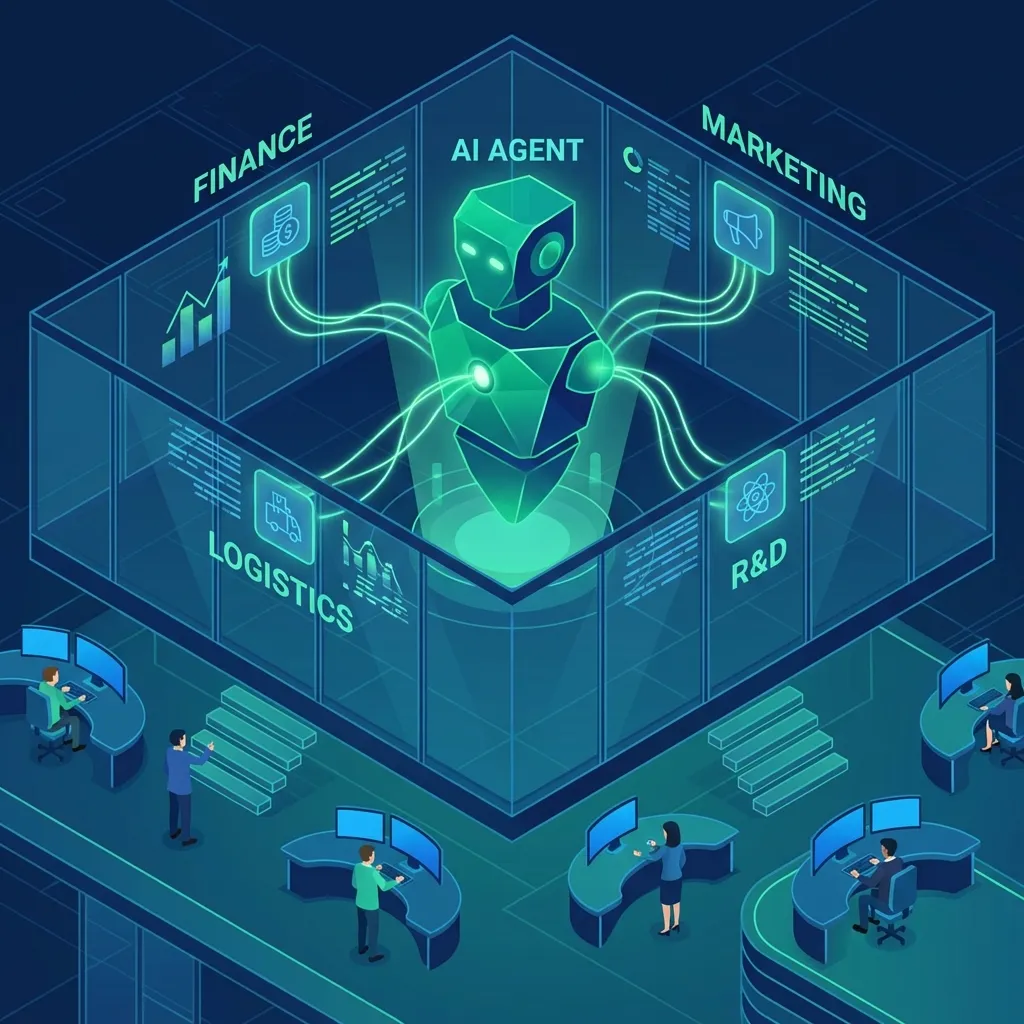
Multiple specialized agents collaborate, each handling a portion of the workflow. A supervisor agent coordinates handoffs and manages overall progress.
Best for: Complex workflows spanning multiple domains. Example: A "deal desk" system might include a pricing agent, a contract agent, a compliance agent, and a scheduling agent, coordinated by an orchestrator.
Human-in-the-Loop Hybrid
Agents handle routine cases autonomously. Edge cases and high-stakes decisions route to humans. The agent prepares context and recommendations; the human makes the final call.
Best for: High-stakes domains (healthcare, finance, legal) where errors carry significant consequences.
Common Mistakes That Kill Agentic AI Projects
Deloitte estimates that 40% of agentic AI projects will fail by 2027. Understanding why helps you avoid the same fate.
Mistake 1: Automating Bad Processes
The Trap: Taking an inefficient human workflow and giving it to an agent.
The Reality: Agents amplify whatever process you give them. If your refund process involves seven unnecessary approval steps, the agent will faithfully execute all seven. You have not improved anything. You have just made it faster to be inefficient.
The Fix: Redesign the process for agent capabilities before implementation. Eliminate unnecessary steps. Consolidate decision points. The best agentic implementations look nothing like the human processes they replaced.
Mistake 2: Insufficient Error Handling
The Trap: Building for the happy path only.
The Reality: Agents encounter edge cases constantly. API failures, malformed data, ambiguous instructions, conflicting rules. Without robust error handling, these cascade into customer-facing failures.
The Fix: Design failure modes explicitly. What happens when the CRM is down? When the customer provides contradictory information? When the agent cannot determine intent? Build graceful degradation and clear escalation paths.
Mistake 3: Treating Agents Like Traditional Software
The Trap: Expecting deterministic behavior from probabilistic systems.
The Reality: Agents powered by LLMs can produce different outputs for identical inputs. They can hallucinate. They can misinterpret instructions. Traditional QA approaches that test specific inputs and outputs do not capture this variability.
The Fix: Implement evaluation frameworks that test behavior distributions, not specific outputs. Use techniques like constitutional AI to constrain agent behavior within acceptable bounds. Monitor production behavior continuously, not just during testing.
Mistake 4: No Governance Framework
The Trap: Deploying agents without clear accountability structures.
The Reality: When an agent makes a mistake, who is responsible? Who can modify its behavior? Who reviews its decisions? Without answers, organizations either over-restrict agents (killing ROI) or under-monitor them (creating risk).
The Fix: Treat agents as a "silicon-based workforce" with defined roles, permissions, and oversight. Establish review cadences. Create escalation protocols. Document decision authority clearly.
Mistake 5: Boiling the Ocean
The Trap: Attempting enterprise-wide transformation immediately.
The Reality: Complex, multi-department deployments fail far more often than focused pilots. The variables are too many. The stakeholders are too diverse. The learning is too slow.
The Fix: Start with a single, well-defined workflow in one department. Prove value. Document learnings. Then expand methodically. The organizations winning with agentic AI in 2026 started with boring, limited pilots in 2025.
The Decision Framework: Should You Deploy Agentic AI?
Not every workflow justifies agentic AI. Use this framework to evaluate candidates:
Volume Test
Does the workflow handle 100+ instances per month? Lower volumes rarely justify implementation costs.
Repeatability Test
Are 70%+ of instances handled similarly? High variance workflows require too much custom logic.
Consequence Test
Can errors be caught and corrected before serious harm? Workflows with irreversible, high-stakes outcomes require more careful implementation.
System Access Test
Are the required systems API-accessible? Workflows requiring manual UI interaction are poor candidates.
Measurement Test
Can you clearly measure success? Without metrics, you cannot prove value or guide improvement.
If a workflow passes all five tests, it is a strong candidate for agentic AI. Three or four passes suggest a viable pilot with constraints. Fewer than three indicate you should look elsewhere.
Building vs. Buying: The Platform Decision
You have three paths to agentic AI implementation:
Build Custom (Python + LangChain/CrewAI)
Pros: Maximum flexibility. Full control over behavior. No platform dependencies.
Cons: Requires engineering resources. Longer time to production. Maintenance burden falls on you.
Best for: Organizations with strong engineering teams building core competitive capabilities.
Low-Code Platforms (n8n, Make.com)
Pros: Faster implementation. Visual workflow design. Managed infrastructure.
Cons: Less flexibility for complex logic. Platform lock-in risk. May hit capability ceilings.
Best for: Organizations wanting quick wins without dedicated AI engineering staff. See our comparison of automation platforms for detailed analysis.
Specialized Agentic Platforms (Sierra, Decagon, Relevance AI)
Pros: Purpose-built for agentic use cases. Pre-built integrations. Vendor handles model updates and scaling.
Cons: Highest ongoing costs. Less customization. Dependency on vendor roadmap.
Best for: Organizations prioritizing speed and willing to pay premium for managed solutions.
Partnering with an Agency
Many organizations lack the internal expertise to evaluate options and implement effectively. Working with an AI automation agency provides access to experience across platforms and use cases, accelerating time to value while building internal capabilities.
What Comes Next: Multi-Agent Ecosystems
The current wave of single-purpose agents is just the beginning. The next evolution is multi-agent ecosystems where specialized agents collaborate across organizational boundaries.
Google and Salesforce are already building the Agent2Agent (A2A) protocol to enable cross-platform agent communication. Imagine your sales agent negotiating directly with a prospect's procurement agent. Your legal agent reviewing contracts with a vendor's compliance agent. Your scheduling agent coordinating with a partner's availability agent.
This is not science fiction. Pilots are running today. Production deployments will emerge by late 2026.
Organizations building agentic capabilities now will be positioned to participate in these ecosystems. Those waiting will find themselves interacting with a world of agents through increasingly outdated human interfaces.
Verified Data and Sources
Key Statistics Referenced:
- 40% of enterprise applications will embed AI agents by end of 2026 (Gartner, via Deloitte Tech Trends 2026)
- 37% of business leaders expect to replace workers with AI by end of 2026 (WEF Future of Jobs Report 2025)
- Salesforce reduced support headcount from 9,000 to 5,000 using agentic AI (CEO Marc Benioff, public statements)
- 95% of organizations see no measurable returns from AI adoption (MIT Media Lab, 2025)
- 40%+ of agentic AI projects expected to fail by 2027 (Deloitte analysis)
- Market growth from $5.2B (2024) to $196.6B (2034) for agentic AI (industry analyst projections)
- 15% of daily work decisions will be made autonomously by 2028 (Gartner)
Sources: Deloitte Tech Trends 2026, Gartner, World Economic Forum, MIT Media Lab, Google Cloud AI Agent Trends Report 2026, TechCrunch, HR Dive
The Bottom Line
Agentic AI is not another AI trend to monitor. It is a fundamental shift in how work gets done.
The organizations deploying agents today are not just improving efficiency. They are building capabilities their competitors cannot easily replicate. They are training their teams to manage digital workers. They are accumulating data and learnings that compound over time.
The window for early-mover advantage is closing. By late 2026, agentic capabilities will be table stakes. The question is not whether to adopt agentic AI. The question is whether you will be a leader or a follower.
Start small. Prove value. Scale methodically. The technology is ready. The economics work. The only variable is execution.
We build production-ready agentic systems for small businesses and enterprises alike. From initial process mapping through scaled deployment, we handle the complexity so you can focus on results. Book a strategy call to discuss your use case.
Related Articles

Ready to Automate Your Business?
Book a free consultation to discuss how AI automation can save you 40+ hours per month.
Book Free Consultation