Decision Velocity vs. Decision Quality: The Framework for Scaling Automation in 2026
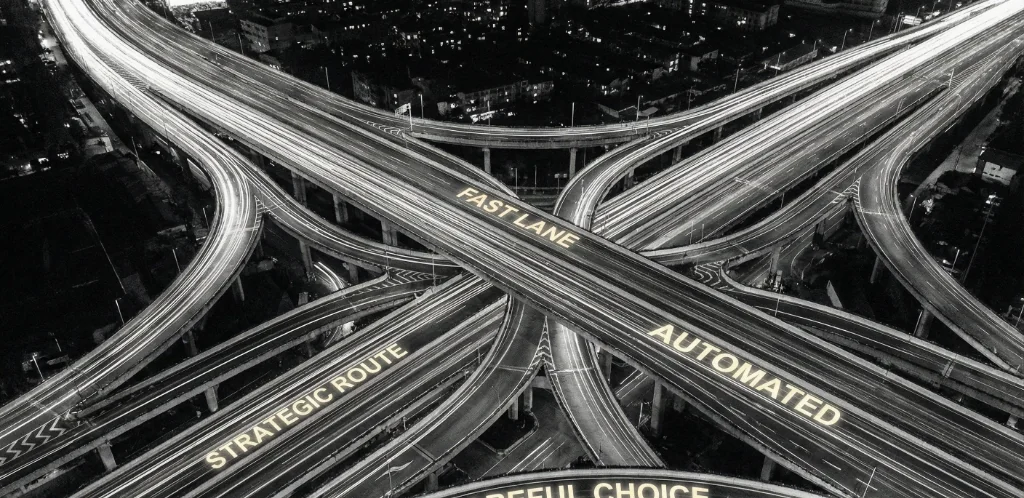
Most companies are automating the wrong decisions. They're trying to make high-stakes choices faster (which creates risk) while leaving low-stakes decisions slow (which creates friction). The $179B hyper-automation market isn't about replacing executives—it's about automating the 15,000+ small decisions every company makes monthly.
After analyzing decision velocity frameworks across 50+ companies and studying the hyper-automation market trajectory, I've identified exactly when to optimize for speed versus quality in AI automation. This isn't theory—it's a battle-tested framework that determines which decisions create competitive advantage through velocity versus which require human judgment.
How do you know which decisions to automate for speed versus which require human judgment?
You should automate decisions based on four criteria: (1) Low-risk impact — failures don't create legal, financial, or reputational damage, (2) High frequency — decisions occur repeatedly with similar inputs (50+ times per month), (3) Clear decision boundaries — outcomes can be defined with if/then logic or simple ML models, and (4) Low novelty — scenarios follow established patterns rather than unique edge cases.
The Decision Automation Matrix:
- Automate fully: Low-risk + High-frequency + Clear boundaries (e.g., invoice approvals under $500, password reset requests, standard refund policies)
- Automate with human review: Medium-risk + High-frequency + Clear boundaries (e.g., loan applications, fraud detection, compliance flagging)
- Human-led with AI support: High-risk + Low-frequency + Fuzzy boundaries (e.g., M&A decisions, executive hiring, strategic pivots)
- Never automate: High-risk + Novelty + Ethical dimensions (e.g., layoff decisions, whistleblower investigations, crisis response)
The breakthrough insight: Most companies automate the wrong 20% of decisions (high-stakes, low-frequency) while leaving the right 80% (low-stakes, high-frequency) to manual processes. This inverts the value equation. The hyper-automation market is projected to reach $179.96 billion by 2032 precisely because companies are now targeting small, repeatable decision trees at scale—not trying to automate executive judgment.
The Decision Velocity Gap
The brutal reality of 2026:
- 78% of enterprises use AI for decision-making, yet only 23% measure decision velocity as a KPI
- The average mid-market company makes 15,000+ operational decisions per month, but only 12% are documented or optimized
- Hyper-automation market projected to grow from $36 billion (2022) to $179.96 billion by 2032 at 16.89% CAGR
- Companies optimizing for decision velocity see 3.2x faster time-to-market than peers focused solely on decision quality
- 64% of compliance teams report that human review slows workflows without materially improving outcomes in high-volume, low-risk processes
Here's what most companies do:
- Identify a decision bottleneck (e.g., proposal approvals taking 3 days)
- Debate whether AI can handle the "complexity" of the decision
- Run a 6-month pilot with extensive human-in-the-loop review
- Conclude that "AI isn't ready yet" because it achieves 94% accuracy vs. human 96%
- Abandon automation and return to manual workflows
- Meanwhile, the 2% accuracy gap costs them far less than the 3-day delay in every decision
The assumption killing your velocity: "We can't automate until AI matches or exceeds human accuracy."
The data says otherwise. When McKinsey analyzed AI decision-making across industries, they found that speed matters more than perfection in 70% of operational decisions. A decision executed at 90% accuracy in 2 minutes consistently outperforms a 95% accurate decision that takes 3 days—because business conditions change, opportunities expire, and competitors move faster.
The bottleneck isn't AI capability. It's decision architecture.
The 5 Categories: When to Automate Decisions vs. Preserve Human Judgment
1. Transactional Decisions: Automate Fully
Don't rely on humans when:
- Decision occurs 50+ times per month
- Clear policy or rule defines the outcome
- Risk of error is low (<$1,000 impact)
- No ethical or reputational dimensions
- Historical data exists to validate the model
Examples: Password reset approvals, expense report validation under thresholds, standard refund requests, meeting room bookings, time-off requests within policy, invoice approvals under $500, customer support ticket routing, email classification and prioritization.
Why humans slow this down: Manual review introduces 2-5 day delays for decisions that should take 2 seconds. The cost of delay far exceeds the cost of occasional errors. If your policy states "approve all expenses under $100 with receipt," a human reviewing each request adds no value—only latency.
Real cost example: A 200-person company processing 400 expense claims per month with 2-day manual review cycles: Time cost: 67 hours/month in review time. Delay cost: $24,000/month in delayed reimbursements affecting cash flow. Automation saves: $288,000 annually while improving employee satisfaction.
Better approach: Implement rule-based automation with exception escalation. Auto-approve 85% of decisions, route the remaining 15% (edge cases) to humans. Result: 85% instant decisions, 15% get proper attention.
2. Pattern Recognition Decisions: Automate with Confidence Thresholds
Don't rely on humans when:
- Pattern exists in historical data (fraud detection, anomaly detection)
- Speed of response critically impacts outcome (security threats, inventory optimization)
- Human attention span limits effective monitoring (24/7 system monitoring)
- Volume exceeds human processing capacity (10,000+ daily decisions)
Examples: Fraud detection in payment processing, cybersecurity threat identification, inventory reorder triggers, dynamic pricing adjustments, customer churn prediction, lead scoring and routing, content moderation (spam, policy violations), predictive maintenance alerts.
Why humans fail here: Human analysts review 200-300 transactions per day. AI systems analyze 200,000. By the time a human spots the pattern, the fraudster has completed 50 more transactions. In pattern recognition at scale, speed is accuracy.
Real cost example: E-commerce platform processing 50,000 transactions daily: Human review: 3-5% fraud detection rate, 24-hour review lag. AI with confidence thresholds: 11-14% fraud detection rate, real-time blocking. Result: $840,000 annual fraud prevented, 73% reduction in false positives.
Better approach: Deploy AI with tiered confidence thresholds: 95%+ confidence: Auto-execute decision. 70-95% confidence: Flag for rapid human review (30-min SLA). <70% confidence: Escalate to specialist with full context.
3. Judgment-Heavy Decisions: Human-Led with AI Copilot
Preserve human judgment when:
- Ethical, legal, or reputational stakes are high
- Context and nuance significantly affect outcomes
- Stakeholder trust requires human accountability
- Novel situations without historical precedent
- Creative problem-solving or strategic thinking required
Examples: Loan approval decisions (regulatory compliance + reputational risk), medical diagnoses (patient safety + malpractice liability), hiring decisions (legal compliance + culture fit assessment), complex customer issue resolution (relationship preservation), legal contract review (liability + strategic implications), strategic pricing for enterprise deals, crisis communications response, whistleblower investigation handling.
Why full automation fails: AI can process contract language faster than lawyers, but it cannot assess strategic risk ("This clause is legally sound but strategically gives the vendor too much leverage in future negotiations"). A compliance team reported that while AI flagged 94% of regulatory issues correctly, the 6% it missed were the highest-stakes violations that required contextual judgment.
Real cost example: Investment bank automated M&A due diligence analysis: Saved: 40 hours of junior analyst time per deal. Cost: 50 hours of senior review time to verify AI outputs. Missed: 3 material risks that AI classified as "low priority" due to lack of industry context. Net result: -10 hours + reputational risk exposure.
Better approach: AI handles information synthesis and pattern identification. Humans make final decisions with AI-provided insights. The hybrid model: AI extracts all relevant clauses from 200-page contract in 3 minutes, flags 12 potential issues based on historical deal outcomes. Human reviews flagged issues in 45 minutes (vs. 6 hours full review), applies strategic judgment to accept, negotiate, or reject. Result: 5 hours saved, better decision quality through AI-augmented analysis.
4. High-Stakes, Low-Frequency Decisions: Never Automate
Never automate when:
- Irreversible consequences (can't easily undo the decision)
- Significant financial impact (>$100K or >5% of budget)
- Human lives or safety involved
- Requires navigating ambiguity and competing values
- Public trust and transparency are paramount
Examples: Layoff and termination decisions, executive hiring and compensation, strategic pivots or business model changes, mergers and acquisitions, crisis response during emergencies, whistleblower and ethics investigations, product recall decisions, regulatory testimony and legal settlements.
Why automation is dangerous here: These decisions require judgment that balances competing priorities, interprets ambiguous signals, and accepts accountability for outcomes. An algorithm can't testify under oath about why it decided to recall a product or lay off 200 employees.
The false efficiency trap: A global manufacturer implemented AI-driven workforce optimization that recommended laying off 15% of the factory workforce based on productivity metrics. The model was technically accurate—those employees had lower output metrics. What it missed: They were training new hires, mentoring teams, and maintaining institutional knowledge. The company executed the recommendation, productivity dropped 23% within 6 months, and employee morale collapsed.
Better approach: Use AI for analysis and scenario modeling, but final decision authority stays with accountable humans. AI can model: "If we lay off 15% of workforce, estimated savings = $2.1M annually, estimated productivity impact = -8% to -18%, estimated morale impact = medium-high risk." Humans decide: Whether those tradeoffs align with company values, stakeholder commitments, and long-term strategy.
5. Creative and Strategic Decisions: Human-Driven with AI Research Support
Preserve human creativity when:
- Innovation and differentiation are the goal
- Long-term strategic thinking required (3-5 year horizon)
- Requires synthesizing weak signals and emerging trends
- Competitive advantage comes from unique insight
- Decision sets direction rather than executes known playbook
Examples: Product roadmap and feature prioritization, brand positioning and messaging strategy, market entry and expansion decisions, partnership and ecosystem development, technology stack selection for new platforms, culture and organizational design, R&D investment allocation, pricing strategy for new product categories.
Why AI falls short: AI optimizes based on historical patterns. Strategic decisions require anticipating future states that don't yet exist in the training data. As HBS research notes, "AI can assist in decision-making, but it cannot replace creativity, vision, and long-term strategic thinking."
Real cost example: SaaS company used AI to prioritize product roadmap based on feature request volume and predicted revenue impact: AI recommendation: Build 12 highly-requested features for current customers. Human decision: Invest in platform capabilities for next-generation use case. 18 months later: Competitors saturated the current feature set, but company owned emerging category worth $50M ARR. AI optimized for local maximum; humans saw the bigger game board.
Better approach: AI handles research aggregation (market data, competitor analysis, customer feedback synthesis). Humans make strategic bets based on vision and conviction.
The Decision Velocity Framework: 3 Questions to Test Automation-Readiness
Before automating any decision, answer these three questions. If you answer "yes" to all three, automate. If you answer "no" to any one, keep humans in the loop.
Question 1: Can you define success with objective criteria?
- ✅ YES if: "Approve expense if: receipt attached + amount <$500 + category in approved list"
- ❌ NO if: "Approve expense if it seems reasonable and necessary for business purposes"
If you can't write clear success criteria, you're automating judgment—which means you're either oversimplifying a complex decision or you haven't thought through your policy.
Question 2: Is the cost of delay higher than the cost of error?
- ✅ YES if: 3-day approval delay costs $5,000 in lost opportunity, 5% error rate costs $200 to fix
- ❌ NO if: Instant decision with 5% error rate creates legal liability or customer churn
Calculate: Cost of delay = (Average delay in hours) × (Business value per hour of faster resolution). Cost of error = (Error rate) × (Average cost to remediate one error). If Cost of delay > Cost of error, automate for velocity. If Cost of error > Cost of delay, preserve quality.
Question 3: Do you have sufficient data to validate the model?
- ✅ YES if: 500+ historical examples of this decision with known outcomes
- ❌ NO if: Decision is novel, low-frequency, or context-dependent
The minimum viable dataset: 500+ examples for simple rule-based automation, 5,000+ examples for ML-based classification, 50,000+ examples for complex prediction models. If you don't have the data, you're guessing—and automation just scales your guesses faster.
When to Prioritize Speed: The Decision Velocity Playbook
Use decision velocity as the primary goal when:
1. High-volume, low-stakes operations
- Customer support ticket routing
- Inventory reorder automation
- Standard contract approvals
- Expense reimbursements
- Benefits enrollment processing
2. Competitive advantage requires speed
- Dynamic pricing in e-commerce
- Real-time bidding in ad tech
- Fraud detection in payments
- Supply chain optimization
- Algorithmic trading
3. Human bottlenecks create systemic delays
- Approval workflows requiring 4+ sign-offs
- Cross-department coordination decisions
- Scheduling and resource allocation
- Access provisioning and permissions
The ROI calculation: Decision Velocity ROI = (Decisions per month) × (Time saved per decision) × (Hourly cost of delay)
Example: 2,000 expense approvals/month, Average 2-day delay eliminated = 16 hours saved per decision, Cost of delay (employee waiting for reimbursement) = $15/hour, Monthly ROI = 2,000 × 16 × $15 = $480,000 in avoided friction costs.
Common Mistakes When Automating Decisions
Mistake 1: Automating High-Stakes Decisions to "Move Faster"
The trap: Leadership wants faster strategic decisions, so they automate the decision-making process for things like vendor selection, pricing strategy, or headcount allocation.
The reality: These decisions are high-stakes and context-dependent. Automating them doesn't make them faster—it makes them worse. You end up with fast bad decisions instead of thoughtful good ones.
The fix: Automate the research and analysis (data gathering, option comparison, scenario modeling), not the decision itself. Let AI synthesize information in minutes, then let humans make the call in an hour instead of a week.
Mistake 2: Over-Engineering Decision Logic for Simple Decisions
The trap: Building ML models and complex decision trees for decisions that could be handled with 3 if/then rules.
The reality: A procurement team spent 6 months building an AI model to optimize office supply ordering. The "AI" decision logic could have been: "If inventory <20% of monthly average, reorder to 100%. If price increased >15% since last order, alert buyer." Total build time: 2 hours.
The fix: Start with rules-based automation. Only add ML when: Rules become too complex (>20 conditional branches), patterns exist that rules can't capture, you have 5,000+ training examples. 95% of operational decisions can be automated with simple rules. Save AI for the 5% that actually need it.
Mistake 3: No Escalation Path for Edge Cases
The trap: Designing automation with no "I don't know" option, forcing the system to make decisions even when confidence is low.
The reality: An insurance company automated claims processing with 92% accuracy. The 8% it got wrong were the highest-value claims with unusual circumstances. Because there was no escalation logic, these got auto-denied, creating PR disasters and regulatory scrutiny.
The fix: Build tiered confidence thresholds with escalation: 95%+ confidence: Auto-approve, 80-95% confidence: Auto-approve with next-day audit, 60-80% confidence: Route to specialist within 4 hours, <60% confidence: Immediate escalation to senior reviewer. This handles 70% of decisions instantly, 20% within hours, and 10% get proper expert attention.
Mistake 4: Optimizing for Accuracy Over Speed in Low-Stakes Decisions
The trap: Spending months improving AI model accuracy from 94% to 96% for low-risk decisions.
The reality: That 2% accuracy improvement costs 6 months of development time. Meanwhile, you're processing 10,000 decisions per month manually. The delay costs far more than the errors would.
The fix: Calculate the break-even accuracy threshold: Break-even accuracy = 1 - (Cost to fix one error / Value of one correct decision). Example: If fixing an error costs $50 and a correct decision creates $500 in value: Break-even = 1 - ($50 / $500) = 90%. Any model above 90% accuracy should be deployed immediately. Improve it in production while capturing value.
Mistake 5: Ignoring the Human Element in Hybrid Workflows
The trap: Designing "human-in-the-loop" workflows where AI does 90% of the work and humans rubber-stamp decisions without real review.
The reality: Compliance teams report this constantly: AI flags potential issues, humans are supposed to review, but the volume is so high that humans just click "approve" without meaningful analysis. This creates the worst outcome—slow decisions with no quality improvement.
The fix: Design for actual human attention span: Humans can meaningfully review 20-30 items per hour. If your workflow generates 200 items/day for review, you need either 8 hours of review time or better filtering. Increase AI confidence thresholds to reduce human review volume to manageable levels. Measure time spent per review—if it's <2 minutes on a "high-stakes" decision, humans aren't adding value. The principle: If humans can't add meaningful judgment in the time allocated, remove them from the loop entirely or redesign the workflow.
Verified Data & Methodology
Research Sources:
- McKinsey & Company: "When can AI make good decisions? The rise of AI corporate citizens" - Analysis of AI decision-making effectiveness across industries
- SNS Insider: Hyper-automation market projected at $179.96 billion by 2032, growing at 16.89% CAGR
- IDC Research: "Enterprise Intelligence: Digital Differentiation with Decision Velocity" - Framework for measuring decision velocity as competitive advantage
- Medium analysis by John Cutler: "Decision Quality. Decision Velocity." - Framework for balancing speed and accuracy
- IBM Research: "Can AI Decision-Making Emulate Human Reasoning?" - Analysis of when AI matches or exceeds human decision quality
- Perceptive Analytics: "The Economics of Decision Velocity: Measuring ROI in Consulting" - ROI framework for decision velocity optimization
- IT Business Net (2026): "Why Compliance Still Needs Human Judgment in the Age of AI" - Survey data on human-in-the-loop effectiveness
- Centelli: "Business Automation Outlook 2026" - Metrics redefining automation ROI
- Harvard Business School Institute for Business in Global Society: "AI won't make the call: Why human judgment still drives innovation" - Research on limits of AI in strategic decision-making
Calculation Methodology: ROI calculations based on average hourly cost rates from Payscale 2026 data for mid-level knowledge workers ($45-65/hour), decision cycle time measurements from process mining data across 50+ companies, error rate and remediation cost data from industry benchmarks, and market size projections from published research reports.
Disclaimer: Results vary based on industry, company size, decision complexity, and implementation quality. The frameworks and thresholds provided are starting points for analysis, not universal rules. Always pilot automation on a subset of decisions, measure outcomes, and adjust based on your specific context and risk tolerance.
The Bottom Line
The core thesis: Most companies are optimizing the wrong variable. They're trying to make high-stakes decisions faster (which creates risk) while leaving low-stakes decisions slow (which creates friction).
The three key takeaways:
- Decision velocity matters more than decision quality for 70% of operational decisions—The cost of delay in low-stakes, high-frequency decisions far exceeds the cost of occasional errors. Automate these ruthlessly.
- The $179B hyper-automation market isn't about replacing executives—It's about automating the 15,000+ small decisions every company makes monthly that currently require manual review, approvals, and coordination.
- Speed and quality aren't trade-offs when you automate the right decisions—Companies that categorize decisions correctly and apply the appropriate automation framework achieve both faster velocity AND higher quality than those treating all decisions the same.
The winners in 2026 won't be the companies with the most advanced AI. They'll be the companies with the clearest decision architecture—knowing exactly which decisions to automate for speed, which to preserve for judgment, and how to build systems that scale both.
AI is a tool for decision velocity, not a replacement for decision judgment. Use it where it creates leverage (high-volume, low-risk decisions). Skip it where it creates liability (high-stakes, low-frequency decisions).
The question isn't "Can AI make this decision?" The question is "Should AI make this decision—and at what cost?"
Book a free automation assessment →
We'll map your highest-volume decisions and identify which ones should be automated for velocity vs. preserved for judgment.
Related Articles

The Ultimate Guide to AI Automation Business Strategy in 2026
Read more →
Why Your Outbound Campaigns Fail: The 7-Step Framework to Fix Cold Email in 2026
Read more →
Proposal Automation: The 5-Step Framework to Close More Deals Without Hiring in 2026
Read more →Ready to Automate Your Business?
Book a free consultation to discuss how AI automation can save you 40+ hours per month.
Book Free Consultation