39 Sales Opportunities from 1,900 Cold Emails: The ROI Math
Everyone obsesses over cold email reply rates. But reply rates are a vanity metric. What actually matters is opportunities: real sales conversations with qualified prospects. We just ran two campaigns that generated 39 opportunities from 1,913 emails. Here is the math that makes cold outbound one of the highest-ROI channels available.
The Raw Numbers
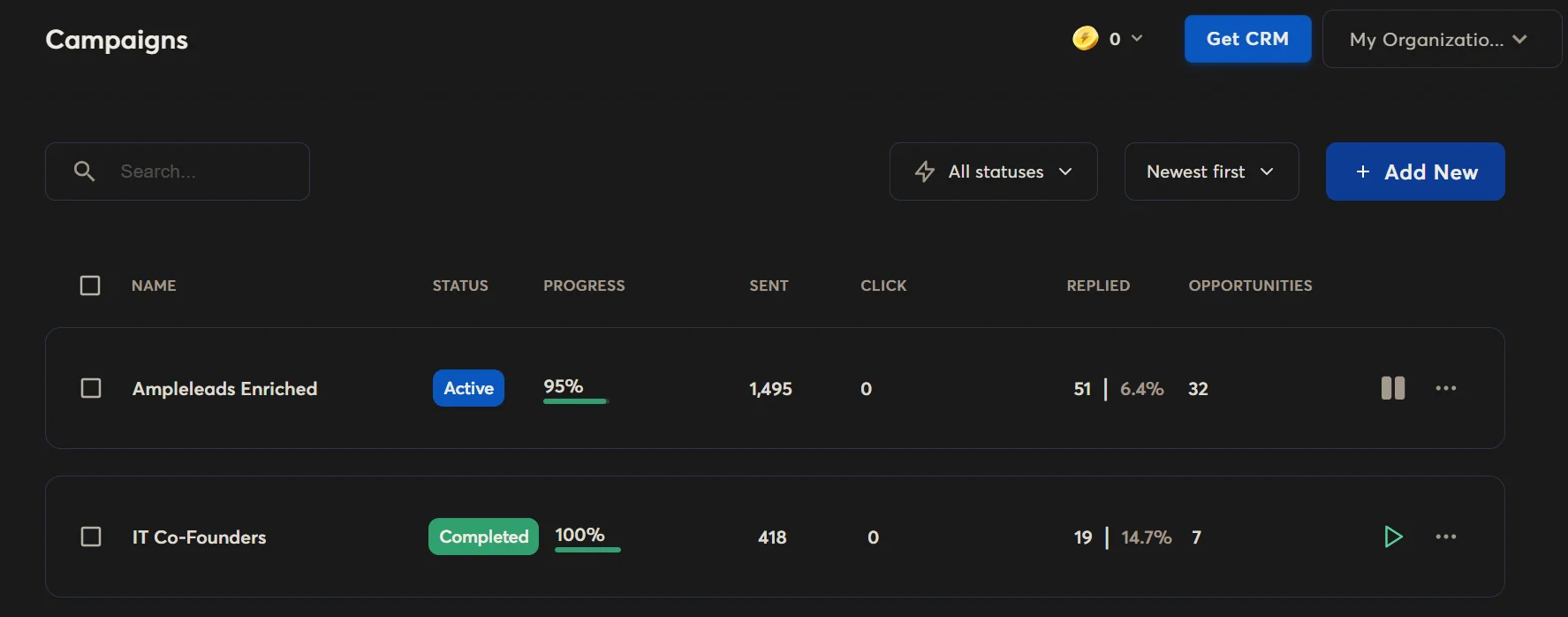
Here is what our dashboard looked like after running these campaigns:
Campaign 1: Ampleleads Enriched
- Emails Sent: 1,495
- Replies: 51 (3.4% reply rate)
- Opportunities: 32 (2.1% opportunity rate)
- Reply-to-Opportunity: 62.7%
Campaign 2: IT Co-Founders
- Emails Sent: 418
- Replies: 19 (4.5% reply rate)
- Opportunities: 7 (1.7% opportunity rate)
- Reply-to-Opportunity: 36.8%
Combined Totals
- Total Sent: 1,913 emails
- Total Replies: 70 (3.7% average)
- Total Opportunities: 39 (2.0% opportunity rate)
The ROI Math
Let us calculate the actual cost per opportunity.
Monthly Infrastructure Cost
- Email infrastructure (Google Workspace): $40
- Email finding (Anymail Finder): $45 (amortized - purchased every other month)
- AI personalization (OpenRouter): $3 (amortized - topped up quarterly)
- Sending platform (Instantly): $42
Total Monthly Cost: $130
With this setup, we sent 1,913 emails and generated 39 opportunities.
Compare this to other lead generation channels:
- LinkedIn Ads: $50-150 per lead
- Google Ads (B2B): $30-100 per lead
- Trade Shows: $200-500 per lead
- Cold Email: $5-15 per opportunity
Why Opportunity Rate Beats Reply Rate
Notice something interesting in the data. Campaign 2 (IT Co-Founders) had a higher reply rate (4.5% vs 3.4%) but a lower opportunity rate (1.7% vs 2.1%).
Why? The IT Co-Founders campaign attracted more "not interested" responses. People replied, but fewer converted to real conversations.
Campaign 1 (Ampleleads Enriched) had fewer replies, but those who did reply were more likely to become opportunities. The reply-to-opportunity conversion rate was 62.7% compared to 36.8%.
This teaches us something critical: optimize for the right replies, not just more replies.
How to Improve Your Opportunity Rate
1. Qualify Before You Send
Do not email everyone who fits a job title. Add filters:
- Company size (employees or revenue)
- Tech stack indicators
- Hiring signals
- Funding stage
The Ampleleads campaign used enriched data with multiple qualification layers. That is why the reply-to-opportunity rate was so high.
2. Make Your CTA Low-Friction
Do not ask for a 30-minute call in your first email. Ask for interest:
- "Worth a conversation?"
- "Open to learning more?"
- "Make sense to connect?"
Low-friction CTAs get more replies, and those replies convert better because people self-select.
3. Send at the Right Volume
Notice the campaign sizes: 1,495 and 418 emails. Not 10,000. Not 50,000.
At these volumes, you can:
- Maintain quality personalization
- Respond to every reply within hours
- Iterate on messaging quickly
Blasting 50,000 generic emails might get more total replies, but your opportunity rate will collapse.
The Pipeline Impact
What do 39 opportunities actually mean for a business?
Assume a 25% close rate (reasonable for warm opportunities from cold outreach) and an average deal size of $5,000:
- 39 opportunities x 25% close rate = 9.75 closed deals
- 9.75 deals x $5,000 = $48,750 revenue
- Cost: $130
- ROI: 375x
Even if you cut these numbers in half (12.5% close rate, $2,500 deal size), you are looking at:
- 4.875 deals x $2,500 = $12,187 revenue
- ROI: 94x
Conclusion
Stop chasing reply rates. Start tracking opportunity rates.
Our two campaigns generated 39 qualified sales conversations from under 2,000 emails at $6.23 per opportunity. That math works for almost any B2B business.
The formula is simple:
- Clean, qualified data (not just verified emails)
- Messaging that attracts buyers, not browsers
- Volume that allows quality follow-up
Get those three right, and cold email becomes your most predictable revenue channel.
Related Articles



Ready to Automate Your Business?
Book a free consultation to discuss how AI automation can save you 40+ hours per month.
Book Free Consultation